
Tree Stump Removal & Grinding
in Walsall & West Midlands
100% Satisfaction Guaranteed across Walsall, Wolverhampton,
Sutton Coldfield, Aldridge, Cannock & West Midlands

Quote by Email
Send us a photo of your stump along with a brief description, and we will provide an indicative price without needing to visit. Email office@aandjtreeservices.co.uk or call us.
Local Experts in Tree Stump Removal
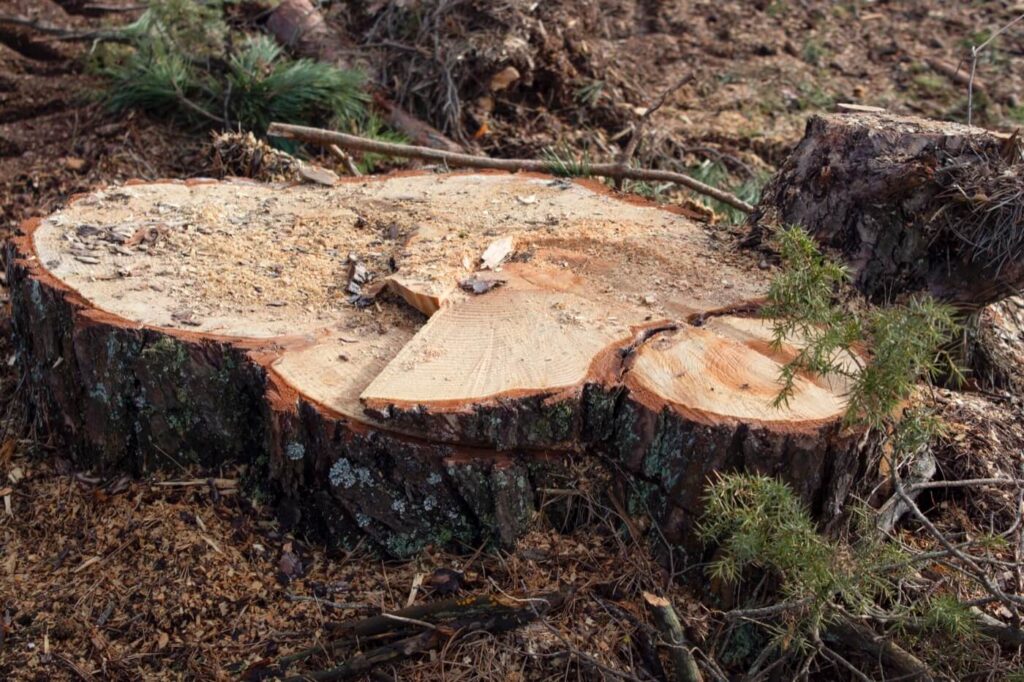
A tree stump left behind after felling is more than just an eyesore. It is a trip hazard, a breeding ground for fungal infections like honey fungus, and a source of persistent regrowth that can be difficult to control. A and J Tree Services removes tree stumps quickly and efficiently using professional stump grinding equipment, leaving you with a clean, level area that can be turfed, planted, or built upon.
We serve homeowners, landlords, schools, care homes, businesses, and commercial properties across Walsall, Wolverhampton, Dudley, Cannock, Willenhall, and the wider West Midlands. Our fleet includes tracked stump grinders for large, accessible stumps and narrow-access pedestrian machines that fit through a standard garden gate — so no stump is out of reach.
How Stump Grinding Works
Our stump grinding machines use a rotating cutting wheel with carbide-tipped teeth to chip away at the stump, grinding it to a depth of eight to twelve inches below ground level. The hole is filled with the wood chippings produced during the process, which decompose naturally over time. The area can then be levelled with topsoil and re-seeded or turfed.
Tree Stump Removal and Stump Grinding: The Complete Guide for Property Owners in the West Midlands
Tree Stump Removal and Stump Grinding: The Complete Guide for Property Owners in the West Midlands
After a tree has been felled, the stump that remains is easy to overlook — at least initially. It sits flush with the ground, or perhaps a few inches above it, and in the immediate aftermath of a tree removal job it barely registers among the bigger changes to the garden. But over the weeks and months that follow, that stump starts to make its presence felt. Grass grows around it awkwardly. Mowing becomes a nuisance. Fungal growth appears on and around the decaying wood. Vigorous new shoots spring from the roots, creating a thicket of regrowth that needs constant cutting back. And the stump itself becomes a trip hazard, an eyesore, and a permanent obstacle to any plans for the space it occupies. A and J Tree Services provides professional tree stump removal and stump grinding across Walsall, Wolverhampton, Dudley, Cannock, Willenhall, and the wider West Midlands, and we have dealt with stumps of every size, species, and level of difficulty.
The first question most people ask is what the difference is between stump removal and stump grinding, and which one they need. These are two distinct methods with different outcomes, and the right choice depends on what you plan to do with the area afterwards. Stump grinding is by far the more common method and involves using a specialist stump grinding machine to mechanically chip away at the stump, reducing it to a mixture of wood chippings and soil. The machine has a rotating cutting wheel with carbide-tipped teeth that grinds through the wood and the upper portion of the root system, typically to a depth of eight to twelve inches below ground level. The resulting hole is filled with the wood chippings produced during the process, and over time these break down and settle. The area can then be levelled, topsoiled, and re-turfed, or used for planting.
Full stump removal, by contrast, involves physically extracting the entire stump and root ball from the ground. This is a far more invasive process that usually requires an excavator or similar heavy machinery, and it leaves a large hole that needs backfilling with imported soil. Full removal is typically only carried out when the site is being cleared for construction and the foundations require a completely clear area, or when the stump is located where underground services would be affected by grinding. For the vast majority of domestic and commercial situations, stump grinding is the preferred method — it is faster, less disruptive, more cost-effective, and leaves the ground in a condition that can be restored relatively easily.
The reasons for removing a stump go beyond simple aesthetics, although the visual improvement is certainly a significant benefit. Perhaps the most compelling practical reason is the trip hazard that stumps create, particularly in gardens where children play, in commercial properties where the public has access, or in school and care home grounds where there is a heightened duty of care. A stump that is partially concealed by grass or leaf litter is a genuine safety risk, and property owners have a legal responsibility under the Occupiers’ Liability Act to ensure their land is reasonably safe for visitors. Having a stump ground out eliminates this risk entirely.
Fungal decay is another important consideration. A dead stump is essentially a large block of dead wood sitting in the soil, and it will inevitably be colonised by fungi. While some of these fungi are harmless decomposers that simply break the wood down over time, others can be more problematic. Honey fungus, in particular, is a serious concern. This aggressive pathogen spreads through the soil via black, bootlace-like rhizomorphs and can infect and kill healthy trees, shrubs, and hedging plants in the surrounding area. If the tree was removed because of honey fungus, leaving the stump in the ground provides a continued food source for the fungus and increases the risk of it spreading to nearby plants. Grinding the stump out removes the bulk of the infected wood and disrupts the fungal network, although it is worth noting that honey fungus can persist in root fragments that remain in the soil.
Regrowth is a practical nuisance that many homeowners underestimate. When a tree is felled, the root system remains alive for a considerable period, and many species will produce vigorous suckers — new shoots that emerge from the roots around the base of the stump. Some species are particularly aggressive in this regard: cherry, plum, poplar, willow, and tree of heaven are all notorious for producing dense thickets of sucker growth that can appear several metres away from the original stump. These suckers need constant cutting back and can damage lawns, paths, and even the foundations of buildings if left unchecked. Stump grinding destroys the connection between the root system and the stump, which significantly reduces or eliminates sucker production.
“Stump grinding is one of those jobs where the result is almost invisible, which is exactly the point,” says Andrew Jones, owner of A and J Tree Services. “The customer goes from having an ugly stump in the middle of their garden to having a flat, usable area that they can turf over or plant up. It is one of the most satisfying transformations we do.”
The stump grinding process itself is relatively straightforward for the customer, although it requires specialist equipment and expertise to carry out safely. The grinding machine is positioned next to the stump and the cutting wheel is lowered onto the wood, sweeping back and forth to grind the stump down layer by layer. The size of the machine used depends on the size and location of the stump. For large stumps in accessible positions, we use a tracked stump grinder that can handle any diameter efficiently. For stumps in tight spaces — behind sheds, in narrow side passages, against walls — we use a narrow-access pedestrian grinder that can fit through a standard garden gate. In rare cases where even a pedestrian machine cannot access the stump, chemical stump treatment may be recommended as an alternative, although this is a much slower process that takes months rather than hours.
Access is one of the most common considerations when quoting for stump grinding work. The machine needs to reach the stump, and depending on the model being used, this may require passage through a garden gate, across a lawn, or through a property. We always assess access during our free site visit and will advise on the best approach. Tracked grinders distribute their weight over a large surface area, which minimises damage to lawns, but we also use ground protection boards where necessary to ensure the customer’s garden is left in the best possible condition.
The cost of stump grinding is primarily determined by the diameter of the stump and the number of stumps to be ground. A small stump of thirty centimetres diameter in an easily accessible location will cost significantly less than a large stump of a metre or more, particularly if access is restricted. There is typically a minimum call-out charge that covers the cost of transporting the machine to the site, and then the price increases with the size and number of stumps. Many customers who have recently had trees removed will have multiple stumps to deal with, and we offer competitive rates for multiple stumps on the same visit. We always provide a fixed written quote after our site visit, so the customer knows exactly what the job will cost before we start.
One question that comes up regularly is how long it takes for the area to recover after stump grinding. The grinding process produces a large quantity of wood chippings, which are used to fill the hole left by the removed stump. These chippings will settle and decompose over the following months, and the ground level will drop as they break down. We advise customers to leave the chippings in place for a few weeks, then top up with topsoil, level the area, and either re-seed or lay turf. In most cases, the area is indistinguishable from the surrounding garden within a single growing season. If the customer wants to plant a new tree or shrubs in the same spot, we recommend waiting at least six months to allow the chippings to decompose sufficiently, and mixing in additional topsoil to provide a suitable growing medium.
It is also worth addressing the question of when stump grinding is not the right approach. If the stump is very close to a wall, foundation, or underground service such as a gas pipe or drain, grinding may risk damaging these structures. The cutting wheel can generate significant forces and vibrations, and while an experienced operator can work very close to hard surfaces without causing damage, there are situations where the risk is too great. In these cases, we may recommend chemical treatment or simply leaving the stump in place and allowing it to decay naturally, which can be accelerated by drilling holes in the stump and applying a proprietary stump killer product. “Every stump is different, and we always give honest advice about the best approach,” says Andrew. “If grinding is going to risk damaging a customer’s drains or a retaining wall, I will say so upfront rather than find out the hard way.”
A and J Tree Services also handles stump grinding for commercial properties, including factory sites, school grounds, care homes, hotel gardens, and business parks. Commercial stump removal often involves multiple stumps across a larger area, and we can provide maintenance contracts that include regular stump grinding alongside other tree services. For commercial clients, we provide full method statements and risk assessments as standard, which is a requirement for many facilities managers and property management companies.
For anyone in Walsall, Wolverhampton, Dudley, Cannock, Willenhall, or anywhere else in the West Midlands who has a tree stump that needs dealing with, the process of getting it sorted is simple.
Call us on 07930 095205, or use the contact form on this website, and we will arrange a free site visit at a time that suits you. We will assess the stump, check the access, and provide a clear written quote. “Most stump grinding jobs are done in less than an hour,” says Andrew. “People are always surprised by how quick it is. They have been looking at that stump for months or even years, and suddenly it is gone.”
Reasons to Remove a Tree Stump
- Trip hazard — especially dangerous in gardens where children play, or on commercial premises with public access
- Honey fungus risk — dead stumps can harbour this aggressive pathogen, which spreads to and kills nearby healthy plants
- Regrowth — many species produce vigorous sucker growth from the roots that requires constant cutting back
- Aesthetics — stumps are unsightly and prevent the area being used for lawn, planting, or landscaping
- Building work — stumps must be removed before laying foundations, patios, driveways, or outbuildings
- Pest habitat — decaying stumps attract wood-boring insects and can harbour wasps’ nests
Stump Removal FAQs
How deep do you grind?
We typically grind to eight to twelve inches below ground level, which is sufficient for turfing and most planting. Deeper grinding is available if required for construction work.
Can I plant over a ground stump?
Yes. We recommend waiting at least six months for the chippings to decompose, then mixing in topsoil before planting. New trees can be planted in the same spot.
How much does stump grinding cost?
Pricing is based on the stump diameter and access. We offer discounts for multiple stumps on the same visit. Contact us for a free quote.
Can you access stumps in tight spaces?
Yes. Our narrow-access pedestrian grinder fits through a standard 70cm garden gate and can reach stumps behind sheds, in side passages, and against walls.
Our Services

We're here to help! Call Us Today!

Have an Emergency?
Need help with a leaking roof or a collapsing chimney our affordable emergency services that are just a call away.


We're here to help! Call Us Today!